Introduction: A New Kind of Partnership
The product development process at Calendly looks familiar on the surface. We conduct user research, write and size product requirement documents, and hold technical design reviews before implementation. The traditional process hasn't disappeared. But, something is shifting. On our Contacts team, engineers using AI coding assistants spend less time wrestling with boilerplate, debugging syntax errors, or scouring outdated blog posts for a technical solution. This time savings gives the team space to think more carefully about the product choices they're implementing, the user journeys they are improving, and the business outcomes they're building toward.
Our product managers and designers have been instrumental in creating the conditions for this shift. Their clarity of vision and strategic thinking — informed as always by a deep understanding of our users — provide the foundation that makes our engineering experimentation possible. Now, as AI tools mature across disciplines, we have an opportunity to elevate everyone's work, not by substituting human judgment, but by taking care of the tedious so we can focus on higher-order thinking, innovation, and deeper collaboration.
The Buzzword That Delivered
Our team approached AI programming tools with healthy skepticism from the start, and we continue to apply that same skepticism to most claims about AI. After watching cloud, containers, and blockchain cycle through as buzzwords, the exaggerated predictions around AI feel exhaustingly familiar. That said, the team has had to revise its position on AI coding assistants specifically, because the evidence became impossible to ignore. Over 85% of Calendly's engineering team now regularly uses these types of tools, saving an average of 4+ hours per engineer per week. When that many engineers voluntarily adopt something and consistently report concrete time savings, you pay attention.
The productivity gains aren't even the most interesting part of the story. We're more fascinated by what engineers are doing with the time saved by using these tools and how it's changing our partnership with product and design. The truth is, engineers have never been just programmers. We have always been problem solvers first who happen to use code as our primary tool. AI is making this distinction even more apparent. When writing code becomes faster and easier, what remains is the essence of what we've always done: understanding problems deeply, architecting solutions, making tradeoffs, and collaborating across disciplines to build the right thing.
Rapid Validation Changes the Conversation
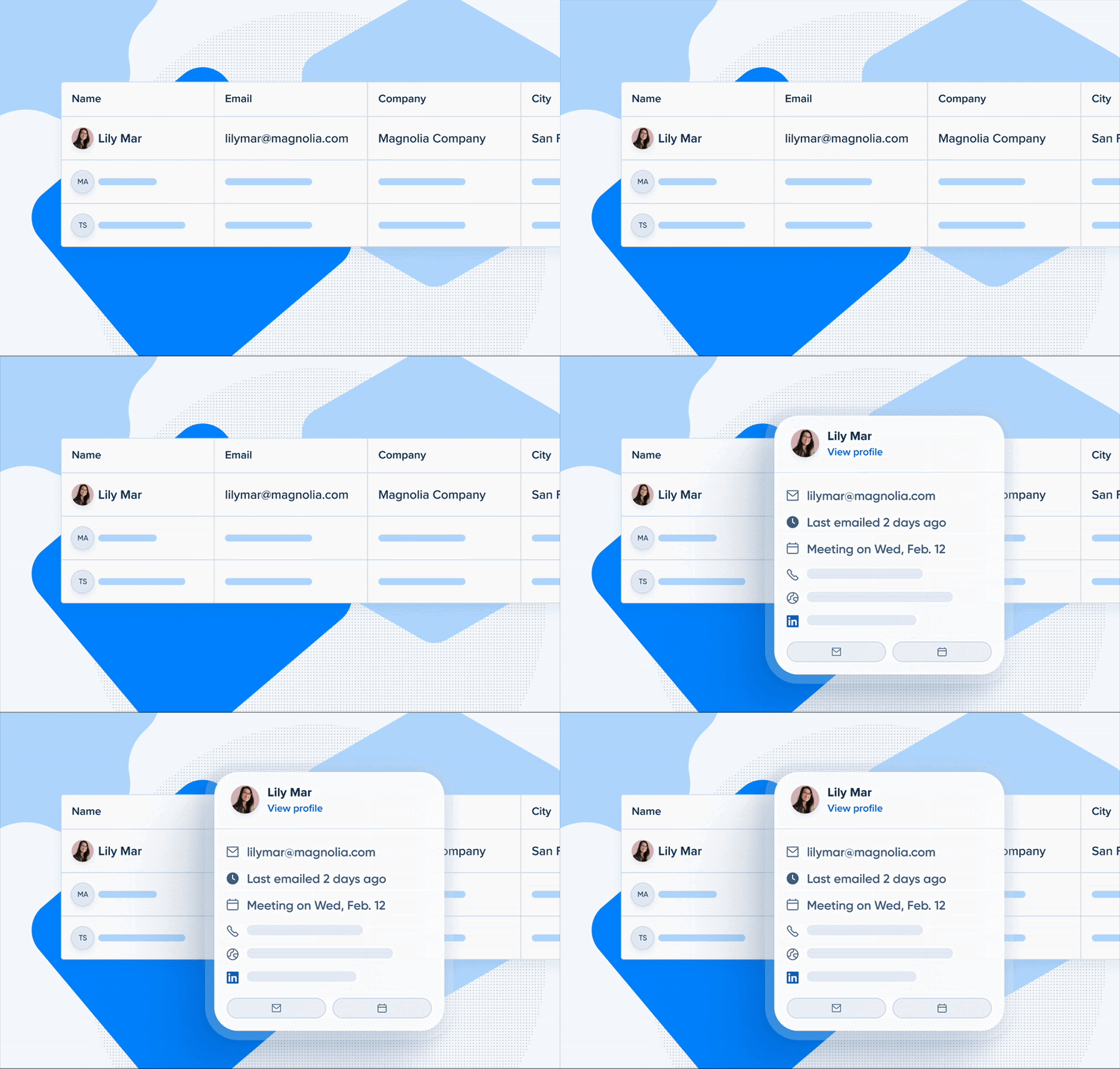
Earlier this year, our product team identified an opportunity to show contact details and quick actions like sharing availability or booking a meeting when users hover over names within the contacts page. We had a clear vision, obvious user value, and a frictionless way to build it. Instead of the traditional cycle of writing up the idea and scheduling multiple discussions, our team built a working proof of concept (POC) in an afternoon using Cursor.
The POC included the core interaction model, basic data fetching, and a functional hoverable UI. We could see it, click it, test it. This rapid prototyping didn't bypass our product process, it enhanced it. The conversation shifted from "should we build this?" to "how should we refine this?" Our product partners could immediately see their vision brought to life and provide specific feedback about what worked and what needed adjustment.
Product had done their job: identifying the opportunity, validating the value, defining their idea. AI tools gave the engineering team leverage to build to our product team’s vision faster, moving from "what if" to "here's how it works" in hours instead of days.
Where the Bottleneck Moved
Engineering capacity remains a constraint on our team. We still have more ideas than we can build and a team of very talented people ready to build anything we set our minds to. But there's a bottleneck that's become even more prominent in the AI era—the alignment tax. That is the meetings, documentation, and communication overhead required to get everyone on the same page about what to build next and why.
The best outcomes still emerge from thoughtfully detailed requirements backed by validated user research, careful prioritization against other work, and clear articulation of market value. Our product partners excel at this strategic thinking, and these skills remain irreplaceable. But when engineering can move from concept to working prototype in hours instead of weeks, there's mounting pressure on the entire product development cycle to accelerate, including the discovery and definition phases that have traditionally set the pace.
This raises a provocative question: if AI tools are fundamentally transforming how engineers work, what happens when they transform how product teams work, too? And more specifically, could AI help reduce the alignment tax itself, not just speed up the execution that comes after it?
How AI Reduces Product Risk
One of the most valuable impacts of AI-accelerated engineering is our ability to discover we shouldn't build something before we invest heavily in it. Traditional product development operates on flawed economics: by the time you've written specs, created designs, estimated effort and allocated sprint capacity, there's momentum to ship. Everyone's invested. The feature is "on the roadmap." Backing out feels like a loss.
AI changes this calculus. When anyone on the team in engineering, product, or design can validate an idea with a working prototype in hours instead of days, the cost of discovering it's the wrong approach drops dramatically. When the prototype reveals that users don't understand the interface, or that the performance implications are worse than expected, or that the feature solves a problem nobody actually has, we haven't failed. We've succeeded at learning something valuable before it was expensive to learn it.
This inverts one of the oldest tensions in product development: the tradeoff between moving fast and making good decisions. Previously, moving fast meant cutting corners on validation, while being thorough meant slowing down. Now, speed and validation reinforce each other. The faster you can build, the more you can validate. The more you validate early, the less waste you create later. When validation becomes this much faster, the traditional boundary between product and engineering starts to dissolve. Both engineers and product managers need to think in terms of rapid experimentation, user value and strategic direction, not just their traditional swim lanes.
The Emerging Opportunity: Accelerating Product and Design Workflows
Our product managers and designers at Calendly are extremely talented. They bring deep user empathy, strategic vision, and the ability to balance competing priorities. They're also beginning to explore how AI tools can amplify their workflows. If product partners, who already excel at strategic thinking, could move faster on execution with the help of AI tools, they could multiply their impact in the same way engineers have been able to.
Validate Ideas Before They Reach Engineering
Product partners could build interactive prototypes with working logic to test with users, explore different UX flows with realistic interactions, and demonstrate concepts to stakeholders with functional demos. The gap between "describing an idea" and "showing how it works" could collapse for product teams the same way it has for engineering.
This shift could fundamentally change how we approach discovery and validation. Today, product managers often need to choose between lightweight mockups that are fast but static, or engineering investment that's realistic but expensive. AI tools could unlock a middle ground: prototypes with real interactivity, working state management and edge case handling that feel production-ready to users, but require no engineering resources to build. The result is product teams testing multiple directions in parallel, validating assumptions with real user behavior data, and arriving at sprint planning with far more evidence about what will actually work. This isn’t just faster iteration, it's higher-quality decision making earlier in the product development cycle, when changes are cheapest and learning is most valuable.
Tighten the Design-Engineering Handoff
Today, even our most detailed design specs require interpretation. Engineers translate visual designs into code, making hundreds of micro-decisions about interaction states, styling, and edge cases along the way. This translation layer, while necessary, creates opportunities for design intent to drift.
We're seeing early experiments across the industry where teams pipe Figma designs directly into development tools, generating implementation-ready code that respects design system constraints automatically. This isn't about replacing the thoughtful collaboration between designers and engineers, it's about removing the mechanical translation work that neither group finds particularly energizing.
When the handoff becomes more automated, several things become possible: design intent gets preserved with higher fidelity from concept to production; engineers can focus on what they do best: complex business logic, performance optimization, and making complex architectural decisions; designers gain more agency to push updates to UI components and iterate on interactions without creating engineering bottlenecks; and design systems stay consistent as AI tools enforce design tropes and component patterns automatically, preventing the drift that typically requires dedicated engineering allocation to remediate.
Conclusion
Supporting 1M+ daily meeting bookings for 20M+ users still requires engineers with deep expertise in distributed systems, database optimization, and system reliability. Those skills aren’t going away, but the daily workflow is shifting.
Engineers spend less time on boilerplate and repetitive code, debugging syntax errors, and implementing straightforward UI components. Instead, more time is spent on higher-value work like architectural decisions with business impact, complex system integrations, validating whether we should build something at all, partnering with product management and design teams on user experience and strategic direction, and mentoring others on AI-assisted development.
At Calendly, over 85% of our engineers already work this way and our product and design teams are actively exploring similar leverage. The trajectory is clear: we're moving towards a paradigm where good ideas come from anywhere and can be rapidly tested by anyone with the curiosity to explore them. As AI capabilities evolve, there remains much to learn. Tools will improve, best practices will mature and the technology will become more reliable, but the core insight holds: when you remove friction from exploration, teams build better products.
Appreciations
We'd like to thank our colleagues across Calendly's Product and Design teams for their partnership in exploring how AI tools can enhance our collaboration. Their leadership and product discipline have been instrumental in helping engineering put these new capabilities into practice.. We also want to recognize the engineers on the Contacts team and across Calendly who have embraced AI-assisted development with both enthusiasm and healthy skepticism. By sharing their learnings openly, they've helped the entire organization understand what works, what doesn't, and where the real opportunities lie. This shift toward product-first engineering has been a team effort. One built on trust, experimentation, and a shared commitment to building better products for our users.
Next Steps
Looking ahead, we're committed to continuing our exploration of how AI tools can amplify work across all disciplines: engineering, product, and design. We'll be investing in best practices for AI-assisted prototyping and validation, exploring ways to reduce the alignment tax through better tooling and processes, and experimenting with design-to-code workflows that preserve design intent while accelerating implementation. We're also focused on knowledge sharing across teams, ensuring that insights about what works with AI tools spreads quickly throughout the organization. Each of these efforts shares the same goal: enabling faster validation, deeper collaboration, and ultimately building products that better serve the 20M+ users who rely on Calendly every day.